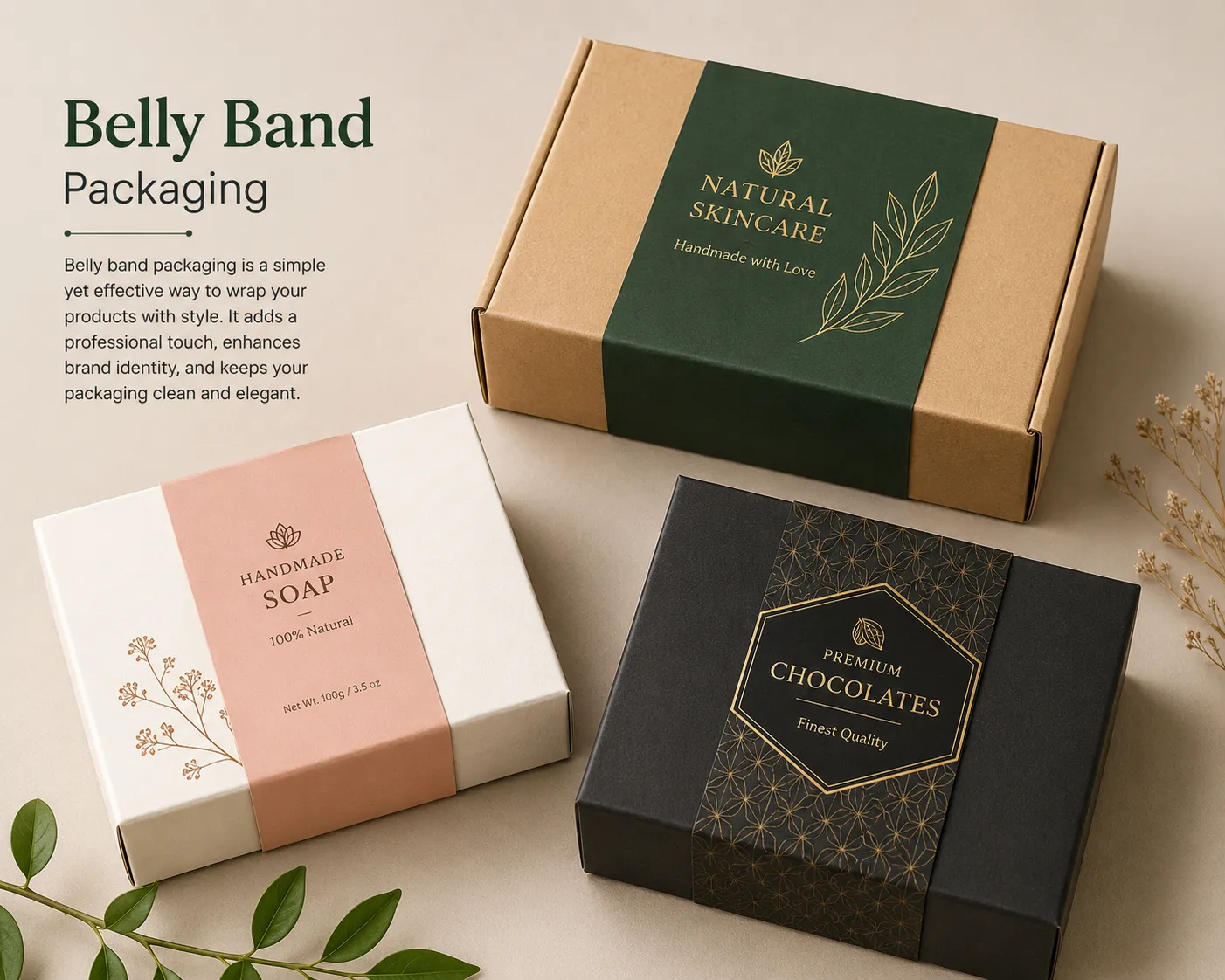
Mylar Bags Pro works with small brands that want custom packaging without redesigning their entire box or bag inventory. Belly band packaging solves that problem directly. It wraps around a plain box, bag, or container and carries your logo, colors, and product details without the cost of printing a full custom container. For a small business watching every dollar, that difference matters.
A belly band turns a generic container into branded packaging in one printed strip. You keep your base packaging simple and let the band carry the branding weight. That keeps costs down while still giving your product a shelf-ready look.
A belly band is a printed paper or cardstock strip that wraps horizontally around a box, tube, or bag and holds closed with adhesive, a seal, or a simple wrap-around fold. Bakeries use them on boxed pastries. Candle brands use them on plain kraft boxes. Soap makers wrap them around unbranded wrapping paper.
Why do so many small brands start here instead of custom boxes? Cost is the biggest reason. A full custom printed box requires new tooling, higher minimums, and a longer production timeline. A belly band prints on a flat sheet, cuts down fast, and wraps around packaging you may already be using.
The band also gives you flexibility other packaging types don't. Running a seasonal promotion or a limited flavor? Print a new band instead of a whole new box run. That single change lets small brands test designs and offers without committing to thousands of custom boxes.
Not every belly band material fits every product. A bakery box needs a different band than a glass jar or a soft pouch.
|
Band Type |
Avg. Cost (per 500 units) |
Durability |
Best For |
Maintenance |
|
Uncoated kraft paper |
60–95 |
Low to moderate |
Dry goods, bakery boxes |
Keep away from moisture |
|
Coated matte cardstock |
90–140 |
Moderate |
Candles, soap, gift sets |
Store flat, avoid heat |
|
Glossy printed paper |
100–150 |
Moderate |
Retail cosmetics, small jars |
Handle to avoid scuffing |
|
Adhesive-backed vinyl band |
150–220 |
High |
Bottles, tubs, moisture-prone items |
Freezer and fridge safe |
Kraft paper bands cost the least and suit dry, shelf-stable products like bakery boxes or coffee bags. Vinyl bands cost more but hold up around moisture, which matters for anything stored in a fridge or shipped through humid climates. A candle brand or gift box seller usually lands on coated cardstock, since it takes color printing well without the added cost of vinyl.
The process behind a printed belly band is shorter than most packaging types, which is part of why small brands like it.
First, you send your logo, product name, and any required label information to your printer. Second, the printer sets up a flat template sized to wrap your specific box, bag, or jar with enough overlap for the seal. Third, the band prints on your chosen stock, usually through digital printing for small runs. Fourth, the sheets get cut to size and, depending on the format, pre-scored for folding. Fifth, you or your packing team wrap and seal the band around the finished product, either by hand or through a wrapping machine for higher volume.
Digital printing keeps setup costs low for belly bands, which fits small order sizes well. According to the Printing Industries of America (2022), short-run digital printing has become the standard choice for packaging runs under 5,000 units because it avoids the plate costs tied to offset printing.
A few factors push the price of belly band packaging up or down more than anything else.
Band width and length change material use, since a taller box or wider jar needs more paper per unit. Print complexity adds cost too. Single-color print runs far cheaper than a four-color design with metallic accents. Stock choice matters as much as print, since vinyl and coated cardstock cost more than plain kraft. Order volume brings the per-unit price down fast, especially past the 1,000 and 2,500 unit marks. Rush production adds roughly 15 to 20 percent to standard pricing.
According to the Paperboard Packaging Council (2023), packaging materials that meet food-grade or direct food contact standards typically run 10 to 20 percent higher than standard stock due to certified coatings and inks. Any brand applying a belly band to a food product in the United States needs to confirm the stock and ink meet FDA food contact requirements, and brands selling into Canada, the UK, or Australia should check the equivalent local standard before ordering.
A soap maker we worked with recently needed a quick rebrand ahead of a holiday market. Reprinting full custom boxes wasn't realistic on their timeline or budget. Switching to a printed belly band over their existing plain kraft boxes gave them a finished, branded look in under two weeks.
Not every printer handles small, flexible packaging runs well. Some shops are built for large box orders and treat a 500-unit belly band job as an afterthought.
A packaging specialist who works regularly with small business orders will ask about your box or container dimensions, your wrap style, and your reorder frequency before quoting a price. Local companies like Mylar Bags Pro focus specifically on flexible and small-run packaging, which means they understand the file setup, stock behavior, and turnaround expectations that small brands actually need.
A supplier who works exclusively on smaller custom runs — like Mylar Bags Pro — will have handled the file sizing quirks, know which stocks hold color well on short runs, and offer reorder support that large-box printers often skip in favor of bigger accounts. That's a real difference, not a marketing claim.
Bakery boxes, candle boxes, soap wraps, small retail boxes, and jars all suit belly bands well. Anything with a flat or slightly curved surface wide enough to wrap cleanly works.
Pricing typically runs from $0.12 to $0.45 per band depending on stock, print complexity, and order volume. Larger runs bring that cost down significantly.
Most printers set minimums between 250 and 500 units for digital printing. Some small-run specialists go as low as 100 units for testing purposes.
Yes, as long as the stock and ink meet food contact safety standards for your selling region. Confirm this with your printer before ordering for any food-adjacent product.
Standard turnaround runs 7 to 10 business days after proof approval. Rush options can bring that down to 3 to 5 days for an added fee.
For many small brands, yes, especially early on. It gives a branded look at a fraction of the cost of custom boxes, though it won't offer the same structural branding as a fully printed box.
Yes. Recyclable kraft paper and compostable adhesive options are available from most suppliers, usually at a slightly higher cost than standard coated stock.
You'll need the exact width, height, and depth of your box, bag, or jar, plus the direction you plan to wrap it, so the printer can size the band correctly.
Coated cardstock and vinyl bands hold up better than plain kraft in humid or refrigerated conditions. Uncoated kraft can soften or wrinkle with prolonged moisture exposure.
Depending on your product and region, you may need to include ingredient lists, allergen information, net weight, or safety warnings under FDA or local labeling regulations.
Yes, though it usually requires a higher minimum order per design version, since each design needs its own print setup even on a shared stock run.
Most use a simple glue dot, adhesive strip, or tuck-and-fold closure. Products stored in the fridge or freezer often need a stronger adhesive rated for cold, damp surfaces.
Picking the right belly band comes down to matching stock and print method to your product and storage conditions. Confirm food contact compliance if it applies to your product, and always request a physical sample before committing to a full run. If you want a packaging partner who understands small-run branding, Mylar Bags Pro can walk you through stock options and sizing based on your existing boxes or bags