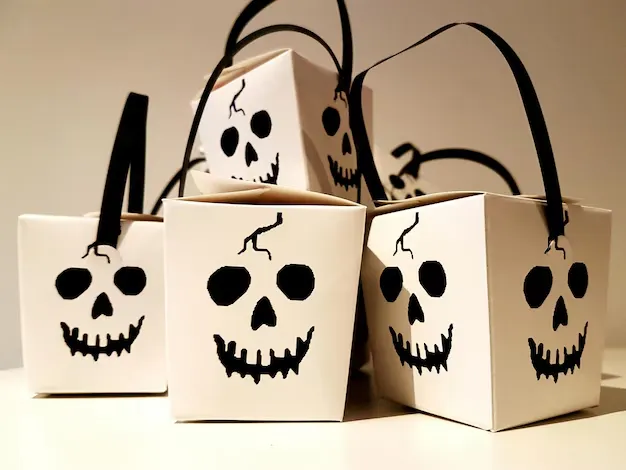
Mylars Bags Pro sees the same pattern every fall: sellers who switch to custom Halloween boxes move products faster than those still using plain cartons. Halloween is a short, intense selling window, and packaging is one of the few levers a small brand can pull fast enough to matter before the season closes.
Why does the box matter this much for a holiday item? Shoppers browsing a seasonal aisle make quick decisions, often in seconds, and a themed design signals "this is for Halloween" before a customer reads a single word on the label. A custom Halloween box does that instantly, where a generic carton needs a sticker or a shelf sign to do the same job.
This guide covers what custom Halloween boxes actually do for sales, the material and style options worth comparing, how the ordering process runs, what drives cost up or down, and how to pick a box supplier who won't leave you short on stock in October.
Halloween spending keeps climbing, and packaging plays a bigger role than most sellers assume. According to the National Retail Federation (2025), total U.S. Halloween spending is projected to reach $13.1 billion this year, with decorations alone accounting for $4.2 billion of that total. That's a lot of shelf competition for a box to win.
Timing adds pressure too. The same NRF survey found that 49% of shoppers start buying Halloween items in September or earlier, which means a box that looks generic in week one of the season loses sales it can never recover later. A custom Halloween box built around your brand colors and a clear seasonal theme earns attention during that early window, when shoppers are still deciding which brands they'll return to for the rest of the season.
There's a retention angle here too. A distinctive box gets reused for storage, gifting, or display, which keeps your branding visible in a customer's home well past October 31st.
Not every Halloween product needs the same box. A bakery selling themed treats has different packaging needs than a costume shop or a candy brand doing bulk orders.
Rigid cardboard boxes hold shape well and print in vivid, high-contrast Halloween graphics, which makes them a strong pick for gift sets and premium items. Corrugated mailer boxes cost less and ship well, suiting online Halloween orders that need to survive transit. Window-cut boxes let the product show through, which works especially well for candy, baked goods, or costume accessories where seeing the item drives the sale. Kraft-style boxes with spot-color print offer a more rustic, seasonal look at a lower per-unit cost, popular with farm stands and smaller candy brands.
|
Box Type |
Avg. Cost (per 100) |
Print Quality |
Best For |
Shipping Durability |
|
Rigid cardboard box |
150–220 |
Excellent |
Gift sets, premium items |
Good |
|
Corrugated mailer |
80–130 |
Good |
Online orders, bulk shipping |
Excellent |
|
Window-cut box |
110–160 |
Very good |
Candy, baked goods, costumes |
Fair |
|
Kraft spot-print box |
60–95 |
Fair |
Farm stands, small candy brands |
Good |
Sellers working with companies like Mylars Bags Pro that focus on holiday and seasonal packaging usually find window-cut boxes strike the best balance for candy and treat products, since customers can see freshness before buying without an extra photo or description doing that work.
Ordering custom Halloween boxes follows a set path, though the timeline moves depending on how far ahead you plan.
You start by sending a logo or seasonal artwork idea, which the supplier turns into a print-ready proof matched to your chosen box style. From there, you pick dimensions based on your product size, since a box sized for a candy assortment won't work for a costume accessory. Once you approve a physical or digital proof, most suppliers run a small test batch so you can check color and print clarity before the full order goes to press. Full production, folding, and quality checks follow, then packing and shipping.
Seasonal timing matters more here than in most packaging categories. A first-time order placed in June or July typically arrives with plenty of room before the September shopping rush; orders placed in late August often carry rush fees of 15% to 25% just to land before Halloween.
A handful of factors swing pricing more than sellers expect, and knowing them early prevents a budget surprise.
Order size is the biggest driver, with per-unit cost often dropping 30% to 50% between a 500-box run and a 5,000-box run. The number of print colors adds cost with each additional pass, and box complexity, like a window cut or a fold-out lid, adds tooling and material charges. Rush timing near peak season, as noted above, adds a real premium on top of standard pricing.
A realistic starting budget for a small brand's first custom Halloween box order runs $200 to $500 for 500 to 1,000 boxes in one or two colors, excluding shipping.
Choosing a box supplier for a holiday product takes more scrutiny than picking any packaging vendor off a search results page.
Confirm the material is food-safe if your product is edible, and ask whether it meets applicable food-contact packaging standards for your market — FDA regulations under 21 CFR in the United States, or the equivalent food-contact certification in the UK, Canada, or Australia. A supplier who hesitates on that question is one to avoid for anything candy or baked-goods related.
A packaging consultant with close to two decades in seasonal and holiday packaging put it plainly: brands that order too late almost always pay more and get less choice in box style, since seasonal print queues fill fast once September starts. That's the real gap between a specialist and a general print shop. A supplier who runs seasonal packaging regularly — such as Mylars Bags Pro — will already know realistic lead times for Halloween, which box styles print cleanly at smaller volumes, and which finishes hold up if boxes sit in a warm stockroom for weeks before the season opens.
Check the minimum order quantity against your actual seasonal volume, ask for a proof step before full production, and get a firm ship date in writing rather than a rough estimate.
If your Halloween product has to compete for attention in a crowded seasonal aisle, the box carrying it deserves the same planning as the product inside. When you're ready to move past plain cartons, reach out to Mylars Bags Pro for a quote and ask which box style fits your product size and order volume. A short conversation about your timeline now can save a scramble in September.
Most are made from rigid cardboard, corrugated board, or kraft paper stock, chosen based on how much protection the product needs and how premium the packaging should look.
Pricing usually runs $60 to $220 per 100 boxes depending on material, print colors, and features like window cuts. Larger orders bring the per-unit price down significantly.
Most suppliers recommend ordering by June or July. Orders placed after mid-August often face rush fees and a smaller selection of available box styles.
Yes, if the product inside is edible. The box or its inner liner needs to meet food-contact packaging standards for your country, such as FDA 21 CFR compliance in the United States.
Many suppliers offer minimum orders starting around 250 to 500 units, which suits a single-location bakery, candy shop, or seasonal pop-up without a warehouse-sized commitment.
A window-cut box has a clear panel so the product shows through, useful for candy or baked goods. A rigid box is fully enclosed and tends to look more premium for gift sets.
Yes. Seasonal spending keeps rising each year, and shoppers browsing holiday aisles respond faster to clear, on-theme packaging than to generic boxes with a sticker added on.
Standard turnaround runs three to five weeks depending on box complexity. Rush production is often available in peak season but adds a noticeable cost premium.
Options typically include one to four spot colors, full-color digital print, matte or gloss coatings, and window die-cuts to show the product without opening the box.
Match the box dimensions to your product's actual size and weight, including any inserts or tissue. A supplier can recommend standard sizes once you share sample measurements.
Recyclable kraft board and soy-based inks are common eco-friendly choices, though they can add slightly to cost. Worth raising directly with your supplier during the quote stage.
Send your artwork or logo file, target box size, expected order volume, and any required features like a window cut, so the supplier can price it accurately on the first pass