At Mylars Bags Pro, we hear the same question from new and growing cosmetic brands almost every week: how do custom lipstick boxes actually get made, and what should a brand budget for them? Packaging is often the first thing a customer touches before they ever try the product inside, so it carries more weight than most founders expect. This guide walks through the materials, the process, the costs, and the questions worth asking before you place an order.
Lipstick boxes protect the tube, hold the label information required by law, and give a brand its shelf identity. Get them wrong and a great formula can still look forgettable. Get them right and a small brand can sit next to a legacy name and hold its own.
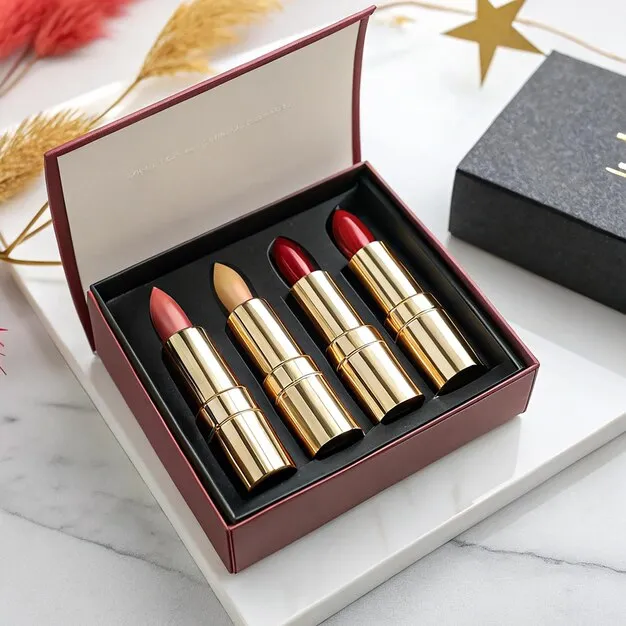
A lipstick box is the small secondary carton that wraps around the tube itself. It usually carries the brand name, shade name, ingredient list, batch code, and barcode, along with whatever design elements the brand wants to lead with.
Why go custom instead of buying stock boxes? A stock box fits the tube, but it says nothing about the brand. Custom boxes let a founder control size, finish, printing, and structural style, which matters more than it sounds. Shoppers form an opinion about quality within seconds of picking up a product, and a flimsy or generic box works against that first impression.
There's also a practical side. Retailers, especially boutique stores and Sephora-style beauty retailers, often have their own packaging standards for shelf display. A box built to the wrong dimensions gets rejected at intake, which delays a launch by weeks. Custom lipstick boxes solve that problem because the dimensions, tuck style, and window placement are set before production, not adjusted after the fact.
The global cosmetic packaging market was valued at 55.38 billion US dollars in 2024 and is projected to grow to nearly 80 billion by 2032, according to Fortune Business Insights (2024). That growth is coming from smaller, independent beauty brands as much as it is from the big names, and packaging suppliers have adjusted their minimum order quantities to match.
Not every lipstick box is built the same way, and the material changes both the cost and the shelf presence. Here's how the main options compare for a typical run.
|
Material |
Avg. Cost (per 100 boxes) |
Best For |
Durability |
|
Kraft paperboard |
60–110 |
Indie brands, natural or eco-focused lines |
Moderate, best for lighter tubes |
|
SBS folding carton (coated) |
90–160 |
Retail launches, printed graphics, matte or gloss finish |
Good, holds crisp print detail |
|
Rigid chipboard |
180–320 |
Luxury lipstick boxes, gift sets, premium shade drops |
Excellent, keeps shape under shipping stress |
|
Corrugated (E-flute) |
70–130 |
Bulk shipping cartons, subscription box inserts |
Good for transit, less refined finish |
Kraft is the budget-friendly, natural-looking choice, and it photographs well for brands leaning into a clean or minimalist identity. SBS folding carton is the workhorse of retail cosmetic packaging: it takes color printing well and holds a crease without cracking. Rigid chipboard is what most luxury lipstick boxes are built from, since it has enough wall thickness to stay square in transit and gives a magnetic-close or two-piece lid a satisfying weight. Corrugated shows up mostly for outer shipping boxes rather than the retail-facing box itself.
Which one fits the first order? Plastic still leads the broader cosmetic packaging market with roughly 64.5 percent share as of 2024, according to a ResearchAndMarkets industry report, but paperboard and rigid stock dominate lipstick-specific packaging because they print better and align with recyclability demands from retailers.
Custom lipstick boxes go through a fairly predictable sequence from concept to delivery.
First, the brand shares tube dimensions, artwork, and any structural preferences, such as a window cutout or magnetic closure. Second, the supplier builds a die line, which is the flat template that shows exactly how the box folds. Third, a physical sample or a digital proof goes back to the brand for approval before anything runs at scale. Fourth, once approved, the boxes print, get die-cut, and go through assembly or folding. Fifth, they ship, usually flat-packed to save freight cost, and get assembled at the brand's fulfillment point or by hand for smaller runs.
A packaging design consultant who works with independent beauty brands put it simply: most delays happen not in production but in the approval stage, when a brand keeps revising artwork after the die line is already locked. Building in one extra review round before file lock saves a week or more on most orders.
Picture a small three-person makeup brand launching four shades for the first time. They chose an SBS folding carton with a soft-touch matte finish over a rigid box, since their budget didn't stretch to rigid stock for a first run. That single material decision cut their packaging cost by close to 40 percent without hurting the shelf look, because the matte coating did most of the visual work.
Cost swings on a handful of variables, and knowing them ahead of time makes budgeting easier.
Order quantity is the biggest lever. Per-unit price drops sharply between 500 and 5,000 units, since setup and plate costs get spread across more boxes. Material choice comes next: rigid stock costs two to three times more than kraft or SBS for the same run size. Finish adds up too, since foil stamping, spot UV, and embossing each carry their own tooling charge on top of the base print cost. Window cutouts, whether die-cut or fitted with a clear PET insert, add a modest per-unit cost but often pay for themselves in shelf appeal. Shipping matters more than founders expect, particularly for rigid boxes, which take up more freight volume than flat-packed folding cartons.
In the US, packaging that touches labeling claims also needs to meet FDA cosmetic labeling rules, which require an ingredient list, net quantity, and manufacturer or distributor information on the box or the product itself. The UK and EU have similar requirements under their own cosmetic regulations, including batch coding and a period-after-opening symbol where relevant. Skipping this step at the design stage means a costly reprint later.
Not every packaging supplier is built the same way, and the difference shows up most when something goes wrong with a run.
A general printer can produce a decent box. A supplier who works specifically in cosmetic packaging will already know tube tolerances, understand which coatings meet cosmetic-safe standards, and have handled the labeling requirements before. Companies like Mylars Bags Pro that focus specifically on custom lipstick boxes and wholesale lipstick packaging boxes tend to catch structural problems, like a window that weakens a fold line, before they reach a full production run.
A specialist supplier working only in cosmetic packaging will have handled batch coding placement, know which laminates hold up against lipstick bullet oils, and carry the print tolerances that a general commercial printer often hasn't tested. That difference rarely shows up in a quote, but it shows up in the sample.
A few questions are worth asking before signing off on a supplier: what's the minimum order quantity, what's the standard turnaround from approved proof to delivery, and can they provide a physical sample before the full run prints? A supplier who hesitates on that last one is worth a second look.
Most suppliers set minimums between 250 and 500 units for a first custom run, though some will go lower for digital printing at a higher per-unit cost.
Kraft and SBS folding cartons typically run $0.60 to $1.60 per box depending on finish, while rigid chipboard boxes run $1.80 to $3.20 per box at similar order volumes.
Kraft and uncoated SBS boxes are widely recyclable through standard paper recycling streams; boxes with foil lamination or plastic windows need to be checked against local recycling guidelines.
The boxes themselves don't need approval, but any labeling claims and required information on them must meet FDA cosmetic labeling rules if the product sells in the US.
Rigid boxes use thick, non-folding chipboard for a premium, structured feel, while folding cartons use thinner boards that ship flat and assemble into shape.
Domestic production typically runs three to five weeks from approved proof to delivery, depending on finish complexity and order size.
Yes, many suppliers offer tiered pricing starting around 250 to 500 units, which keeps per-unit cost manageable for a first product launch.
Soft-touch matte lamination, foil stamping, and spot UV on the logo are the most common finishes for a premium look without excessive cost.
A window isn't required, but it lets shoppers see the shade or tube color before opening the box, which helps at retail counters and in photos.
Rigid and E-flute corrugated options hold up best in transit; thin uncoated kraft boxes are more prone to crushing in bulk shipping without an outer carton.
Yes, most suppliers that serve US brands also ship to the UK, Canada, Australia, and other English-speaking markets, though lead times run slightly longer for international orders.
The UK and EU require similar ingredient and batch labeling under their own cosmetic regulations, along with a period-after-opening symbol on products with a defined shelf life once opened.
Choosing between kraft, SBS, and rigid stock comes down to budget, order size, and how the box needs to perform on a shelf versus in a shipping box. None of those decisions need to happen alone. If you're weighing options for your next production run, Mylars Bags Pro can walk through material samples and pricing tiers for custom lipstick boxes based on your quantity and timeline, without pushing you toward the most expensive option. A short conversation before you lock artwork tends to save both money and a reprint