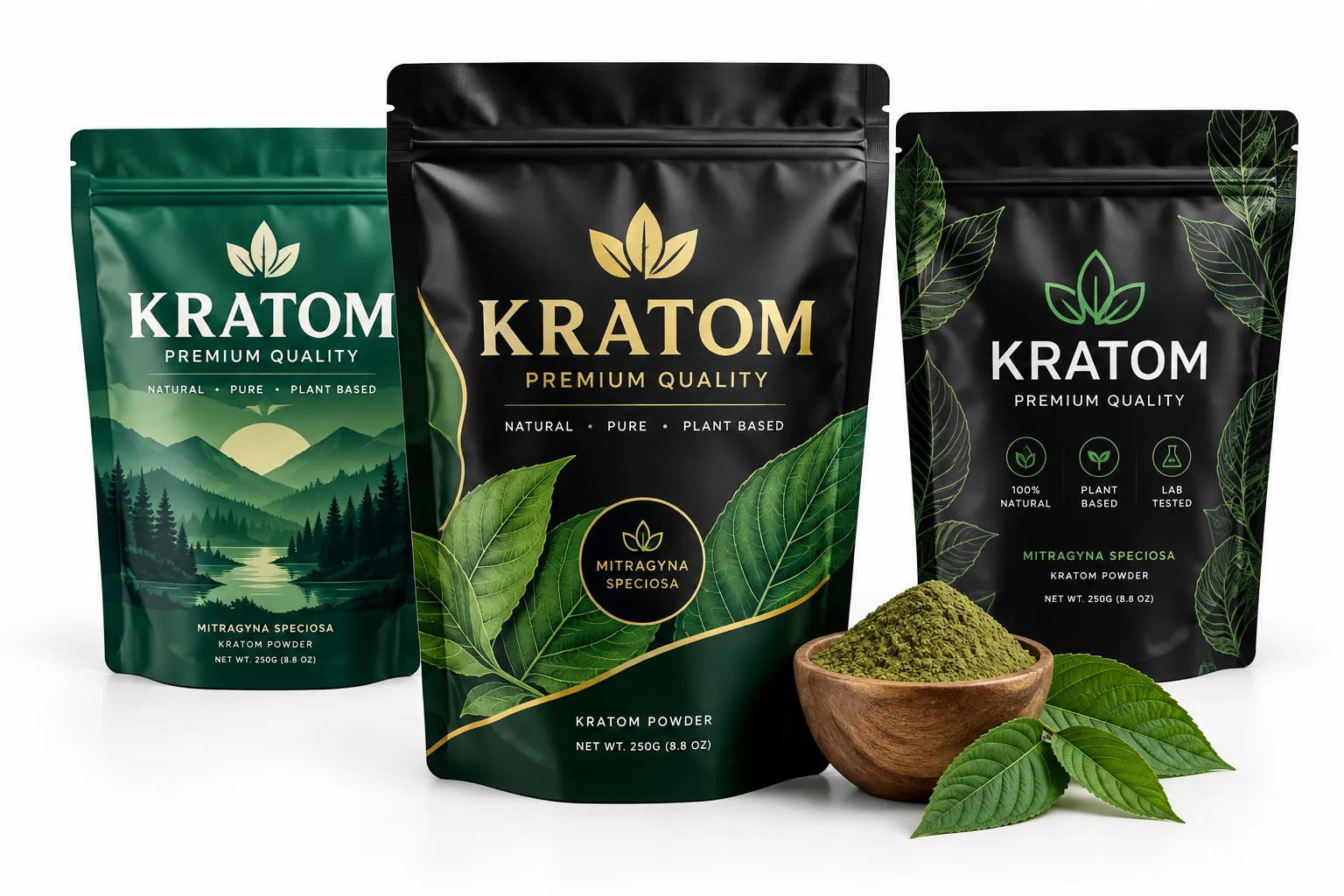
A kratom brand lives or dies on shelf appeal and product freshness, and packaging carries both jobs at once. Custom printed kratom mylar bags protect the powder or leaf from moisture and light while giving a small vendor the branded look that larger competitors already have. At Mylar Bags Pro, we work with kratom sellers every month who are switching from generic bags to something that actually holds up on a store shelf.
This guide covers what makes a mylar bag suited for kratom specifically, how printing and barrier quality affect cost, and what to check before placing a bulk order. We will also look at labeling rules that catch a lot of new sellers off guard.
Kratom powder reacts fast to air, humidity, and light. Left in a thin plastic pouch, it loses potency and can clump within weeks. Custom printed kratom mylar bags solve this with a multi-layer barrier that blocks oxygen and moisture far better than standard poly packaging.
Why does barrier quality matter so much here? Botanical powders like kratom are sensitive to oxidation, and a weak seal shortens shelf life fast. A proper mylar bag, often paired with a one-way degassing valve or a simple zip-lock closure, keeps the product stable from the warehouse to the customer's shelf. This matters for both leaf and powder forms, since powder has more surface area exposed to air.
Brand presentation matters just as much as protection. A generic clear bag with a sticker label looks unfinished next to a fully printed pouch with clear dosage information and brand artwork. Custom printing turns a simple package into a marketing tool, which helps smaller kratom brands compete with established names on a retail shelf.
Not every mylar bag fits every kratom product. Powder needs a tighter barrier than capsules, and larger bulk bags need reinforced seams to survive shipping. Here is how the common options stack up.
|
Bag Type |
Avg. Cost (per 100 units) |
Barrier Rating |
Best For |
Closure Type |
|
Stand-up pouch, matte finish |
$45–$70 |
High |
Retail powder, 1–4 oz |
Zip-lock + heat seal |
|
Flat pouch, gloss finish |
$30–$50 |
Medium-high |
Sample sizes, capsules |
Heat seal only |
|
Bulk kraft-mylar hybrid |
$60–$90 |
High |
Wholesale, 1lb+ orders |
Zip-lock + tin tie |
|
Foil-lined child-resistant bag |
$80–$120 |
High |
Retail requiring CR closure |
Push-lock CR zipper |
A 2023 packaging industry report from the Flexible Packaging Association found that oxygen barrier failures account for a large share of shelf-life complaints in the botanical and supplement category. That statistic lines up with what we hear from smaller sellers: a cheap bag looks fine at first, then fails within a month once the seal starts letting air back in.
Getting from a design file to a finished bag involves a few clear steps. First, the printer converts your artwork into plates or digital print files matched to the bag size and material. Second, the mylar or foil-laminate film gets printed, usually in batches to keep cost per unit down. Third, the printed film gets formed into pouches, sealed on the sides and bottom, and fitted with a zipper or valve if the order calls for one.
Turnaround time runs anywhere from ten days for a digital print run to four to six weeks for a large offset order with custom color matching. Minimum order quantities vary widely. Digital printing often allows orders as small as 250 to 500 units, while traditional gravure printing usually requires 5,000 units or more to justify setup costs.
A packaging consultant who works with supplement brands told us that first-time kratom sellers often underestimate lead time. "People place their first custom bag order two weeks before a product launch and then panic when the printer says six weeks," she said. Planning the packaging order early avoids that scramble entirely.
Several variables push pricing up or down. Bag size is the biggest factor, since a one-pound bulk bag uses more material than a one-ounce sample pouch. Print complexity matters too. A single-color print costs far less than a full-color design with gradients or metallic accents.
Order volume changes the math significantly. A run of 500 bags might cost $0.60 to $0.90 per unit, while a run of 10,000 bags can drop below $0.20 per unit once setup costs get spread across more pieces. Adding features like a child-resistant zipper, a matte soft-touch finish, or a degassing valve for freshly ground powder adds anywhere from five to twenty cents per bag.
Does location affect shipping cost on top of production? Yes, especially for sellers ordering from overseas printers, where freight and customs fees can add ten to fifteen percent to the total order. Domestic printing costs more per unit up front but often balances out once shipping and lead time are factored in.
Picking a packaging supplier comes down to more than price per bag. A general packaging printer can produce a mylar pouch, but a company that focuses specifically on botanical and supplement packaging, like Mylar Bags Pro, tends to understand barrier requirements and labeling space better than a generic print shop handling snack bags one day and kratom bags the next.
Labeling rules deserve attention before any order goes to print. Several U.S. states require kratom products to carry specific labeling, including a statement that the product is not FDA-approved and clear net weight disclosure. The American Kratom Association has pushed for standardized labeling through its Good Manufacturing Practices program, and following that framework on your packaging can help build trust with retailers who are cautious about stocking kratom products. Confirming state-specific packaging rules with a local regulatory contact before a large print run avoids costly reprints later.
A small kratom vendor we worked with switched from a plain zip bag with a printed sticker to a fully custom stand-up pouch with a matte finish and clear net weight labeling. Within two months, three new retail accounts agreed to stock the product, citing the packaging as a reason they trusted the brand enough to take it on.
Custom printed kratom mylar bags do two jobs at once: they protect the product and they sell it on the shelf. Match the barrier level to your product form, plan your print order around realistic lead times, and check labeling rules before you finalize artwork.
If you are ready to move past generic packaging, Mylar Bags Pro can walk you through barrier options, minimum order sizes, and label placement so your first custom run comes out right the first time.
Mylar bags use a multi-layer barrier that blocks oxygen and moisture far better than standard plastic, which keeps kratom powder or leaf fresher for longer. Standard plastic bags let air pass through the material itself, even when sealed tightly.
Pricing typically runs from $0.20 to $0.90 per bag, depending on size, print complexity, and order volume. Larger orders of 5,000 units or more bring the per-bag cost down significantly compared with small runs under 1,000 units.
Digital printing allows orders as small as 250 to 500 bags, while traditional gravure or offset printing usually requires 5,000 units or more. Smaller kratom brands often start with digital printing to keep upfront costs manageable.
Some states require child-resistant packaging for kratom products sold at retail, so checking local regulations before ordering is worth the time. A push-lock CR zipper adds a modest cost increase but avoids compliance issues at the point of sale.
Digital print runs typically ship in ten days to two weeks, while larger offset or gravure orders with custom color matching can take four to six weeks. Planning your packaging order well before a product launch avoids last-minute delays.
Several states require a clear net weight statement and a disclosure that the product is not FDA-approved, along with ingredient information. Following the American Kratom Association's labeling guidance is a practical way to stay ahead of state-level requirements.
Yes, a high barrier mylar bag with a proper heat seal or zip closure can keep kratom powder stable for several months when stored away from heat and direct light. Barrier quality matters more than bag thickness alone for maintaining freshness.
Common finishes include matte, gloss, and soft-touch coatings, each affecting both look and feel on the shelf. Matte finishes tend to show fingerprints less and photograph well for online listings, which is one reason many kratom brands choose them.
A resealable zipper helps preserve freshness after the bag is first opened, which matters for larger bulk sizes that customers use over several weeks. Single-use heat-sealed bags work fine for sample sizes meant to be used in one sitting.
Wholesale orders typically use one-pound or larger kraft-mylar hybrid bags with a tin tie or zip-lock closure for repeated access. Retail-facing products usually fit better in one to four ounce stand-up pouches sized for shelf display.
Yes, humid regions call for a thicker barrier film to prevent moisture from breaking down the powder's texture and potency over time. Sellers shipping to coastal or tropical markets often choose a foil-lined mylar option for extra protection during transit and storage.
Confirm the barrier rating, closure type, and print turnaround time match your product and launch timeline before finalizing an order. It also helps to request a physical sample bag to check seal strength and print quality before committing to a large production run