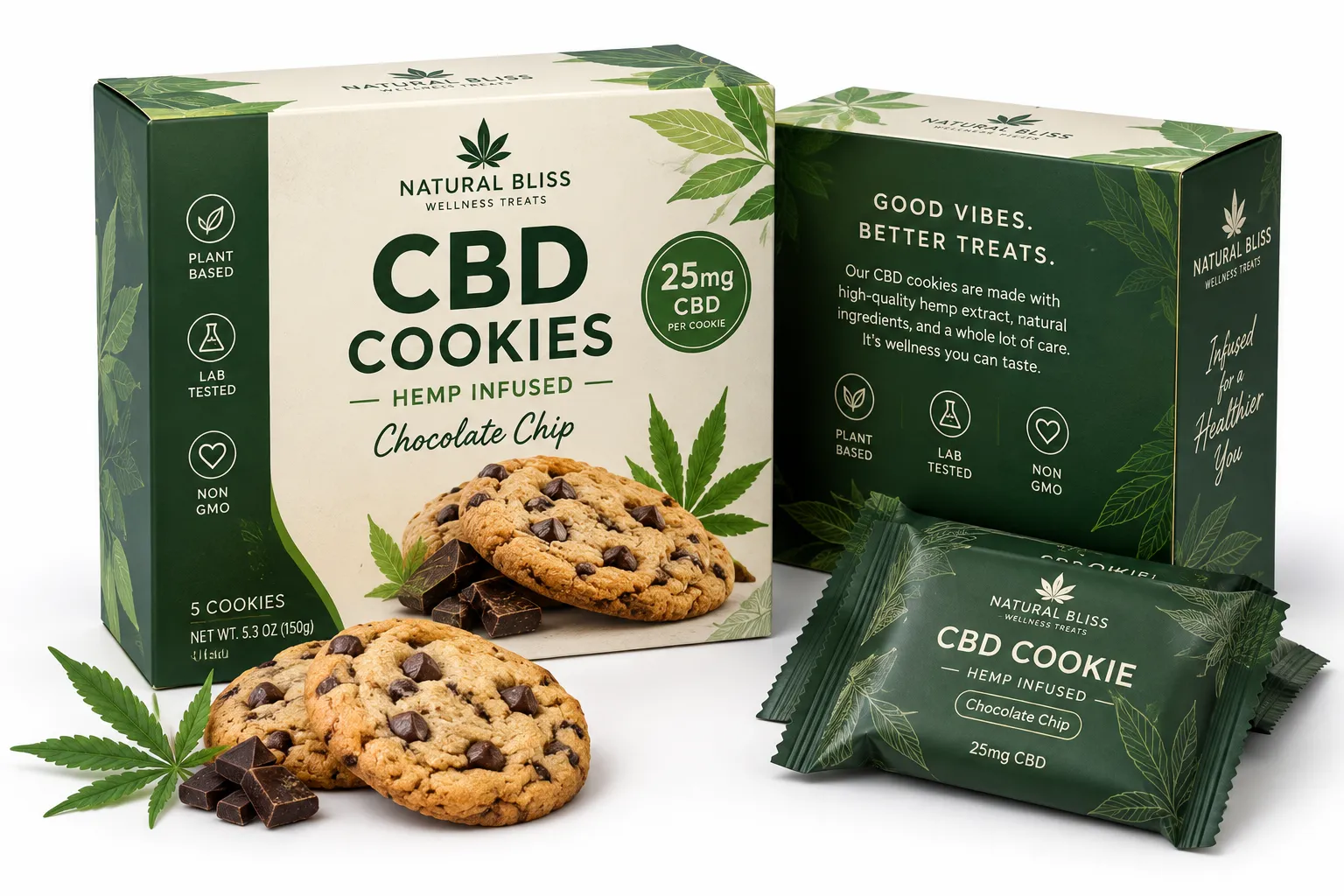
A shopper picking up a CBD cookie for the first time reads the box before they read the ingredient list. Custom CBD cookie packaging boxes carry more weight than standard bakery packaging, since the buyer needs proof of dosage, sourcing, and safety before they trust what's inside. A plain box with a sticker slapped on the front raises questions. A box built for the product, with clear milligram counts and a compliant design, answers them before the shopper asks. Mylar Bags Pro works with small CBD brands on the food-safe barrier liners that go inside these boxes, keeping cookies fresh while the outer box carries the branding and the required warnings. This guide covers what a proper CBD cookie box needs to include, which materials fit different budgets, and how to choose a packaging partner who understands the compliance side, not just the print side.
Ask yourself this: would you buy a snack from a box that hides how much is inside it? Regular bakery boxes focus on looks. Custom CBD cookie packaging boxes carry legal weight too, since most states now require clear cannabinoid content per serving and per package. The FDA has stated that current food and supplement rules don't fit CBD, and that CBD remains an unapproved food additive under the FD&C Act, according to the agency's own 2023 announcement. That gap between federal and state rules means brands lean on packaging to carry the compliance details state law demands.
Design matters just as much as the legal text on the box. The FTC and FDA jointly warned five edible cannabis sellers in 2024 for using packaging that closely resembled popular children's snacks and cereal. A CBD cookie box that leans too close to a regular kids' snack box invites the same scrutiny, so the print design needs personality without crossing into that territory.
Most CBD brands choose between four common box styles, and the right one depends on where the cookies get sold and how the brand wants to look on a shelf.
|
Box type |
Typical cost (per 100 units) |
Child-resistant option |
Best for |
|
Kraft mailer box |
$150–$250 |
Needs a CR insert bag |
Online orders, small-batch brands |
|
Rigid gift box |
$300–$450 |
CR clasp add-on available |
Premium retail, gift sets |
|
Corrugated shipper box |
$180–$280 |
Not inherently CR, pair with CR liner |
Wholesale and bulk shipping |
|
Tamper-evident tin or tray |
$350–$550 |
Certified CR under 16 CFR 1700.15 |
Dispensary and regulated retail |
A good packaging partner walks through a set process, and skipping a step usually shows up later as a compliance problem or a print run that needs a reorder.
Print complexity drives most of the price difference between two similar box styles. A single-color print costs less than a full-color box with foil accents or a matte finish, and the gap grows with order size. Child-resistant features add cost too. The Consumer Product Safety Commission requires cannabis edible packaging to pass testing under 16 CFR §1700.15 and §1700.20 before it can carry a child-resistant claim, and that certification adds both time and money to a production run.
Order volume changes the per-unit price more than almost any other factor. A run of 500 boxes costs more per unit than a run of 5,000, since setup costs spread across more units at scale. Brands selling in states like California face an added layer of detail, since Title 4 of the California Code of Regulations, section 17412, sets specific child-resistant packaging standards for edible cannabis products sold through licensed retail. Meeting that standard from the first print run avoids a costly repack later.
A packaging compliance specialist we spoke with said the most common mistake small CBD brands make is ordering print-only boxes without checking whether the material and closure meet their state's child-resistant rules. One brand launching a cookie line found this out after their first shipment got flagged by a retailer for using a plain flip-top box with no CR feature, forcing a costly reprint just weeks before launch.
A general print shop that occasionally handles cannabis packaging won't always know the current CPSC testing requirements or which states require opaque packaging for edibles that resemble candy or snacks. A partner who works specifically with cannabis and hemp packaging will know which materials pass CR certification and how to build the required warning label into the print file from the start. Suppliers like Mylar Bags Pro, who focus on food-safe barrier bags, often pair with a box printer to give a CBD cookie brand both a compliant outer box and a liner that keeps the product fresh and light-protected.
Ask any packaging partner for proof of past CR certifications before you commit to a print run, not just a portfolio of nice-looking boxes.
Getting custom CBD cookie packaging boxes right means balancing brand design with the labeling and child-resistant rules your state requires. Start by confirming your state's specific requirements, then choose a box style and liner combination that protects the product and looks right on a shelf. When you're ready to talk through liner options that keep your cookies fresh inside a compliant box, Mylar Bags Pro can walk you through the barrier bag choices that pair well with your print run.
Most states require the cannabinoid content per serving and per package, a batch or lot number, and a standardized warning symbol. Some states, including California and Colorado, require the exact milligram content rather than a general warning, so check your specific state's rules before printing.
Prices typically range from $150 per 100 units for a simple kraft mailer box to $550 or more per 100 units for a certified child-resistant tin or tray. Print complexity, order volume, and any child-resistant certification all push the price up or down.
In most states, yes. The Consumer Product Safety Commission requires cannabis edible packaging to pass testing under the Poison Prevention Packaging Act before it can carry a child-resistant claim, and many states now enforce this for CBD and hemp-derived edibles too.
A kraft mailer box paired with a certified child-resistant inner bag suits most small-batch brands, since it balances cost with compliance. A rigid gift box costs more but suits brands selling through premium retail rather than direct online orders.
Most packaging providers set wholesale pricing tiers starting around 500 to 1,000 units, with per-unit cost dropping as order size grows. Confirm your state's labeling requirements before placing a wholesale order, since a large print run with the wrong details is costly to redo.
Yes, both channels generally require the same cannabinoid disclosure and child-resistant features, but retail packaging in licensed dispensaries often faces additional state-specific rules. Check whether your target retailers require independent lab certification for the child-resistant closure before you ship product.
Light and air both degrade cannabinoids over time, so an opaque or UV-blocking box paired with a sealed inner liner extends shelf life noticeably. Cookies stored in clear, unsealed packaging lose potency faster and can also go stale sooner than properly sealed products.
Tamper-evident packaging shows visible signs if someone has opened it before purchase, while child-resistant packaging is specifically tested to be difficult for young children to open. Many CBD cookie boxes now use both features together to meet state retail requirements.
It can borrow bakery-style design elements, but regulators watch closely for packaging that closely resembles popular children's snacks or cereal. The FTC and FDA jointly warned several edible cannabis sellers in 2024 for exactly this reason, so a distinct, adult-oriented design matters.
Any box claiming to be child-resistant needs certification from testing under 16 CFR §1700.15 and §1700.20, usually performed by an accredited third-party lab. Keep those test certificates on file, since some states require proof of certification during licensing or renewal.
A food-safe barrier liner, similar to a mylar-style bag, blocks moisture, light, and air far better than a plain paper insert. Pairing that liner with an opaque outer box gives CBD cookies the best combination of freshness and compliant, tamper-evident presentation.
Order at least four to six weeks ahead of a launch date, especially if the box needs child-resistant certification, since lab testing and proofing both take time. Rush orders are possible with some suppliers but usually cost more per unit