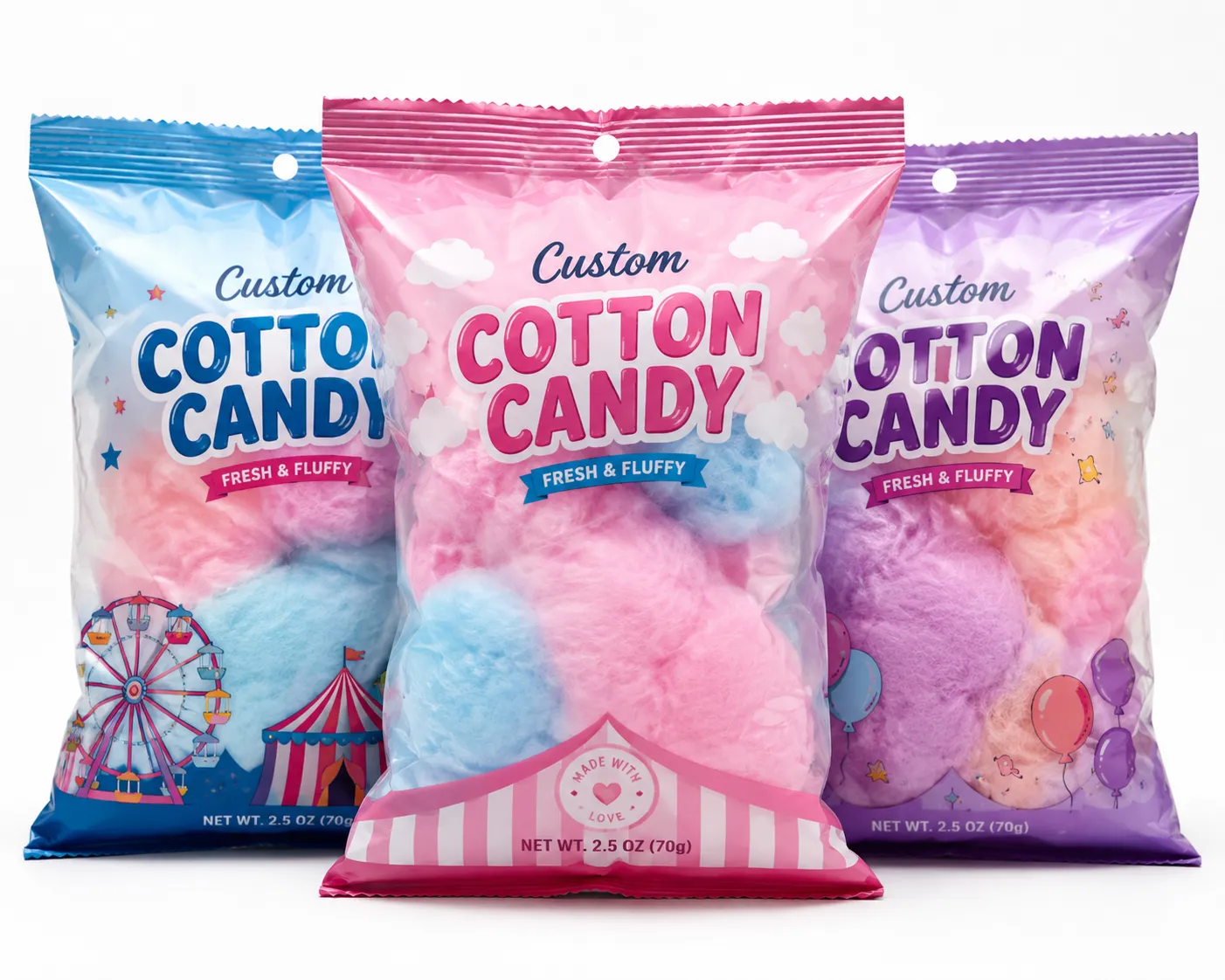
Mylars Bags Pro works with candy makers who know a plain poly bag does nothing for a brand. A cotton candy bag sits in a customer's hand for as long as the treat lasts, and that's free advertising if the design earns it. Custom cotton candy bags turn a throwaway wrapper into a small billboard that carries your name, colors, and logo well past the point of sale.
Why does that matter so much for a product this simple? Cotton candy has almost no shelf life once it's spun, so the bag is doing double duty. It has to keep the product fresh and shaped, and it has to tell people who made it. A candy shop or fair vendor selling from a plain bag loses both jobs at once.
This piece walks through the bag types worth considering, what actually happens during production, what drives the price up or down, and how to pick a packaging partner who won't waste your first print run.
A cotton candy bag isn't just a container. Spun sugar is fragile and sticky, so the bag has to protect texture and shape while the product moves from booth to bag to hand. A poorly sealed bag lets in humidity, and humidity turns cotton candy into a hard, collapsed lump within an hour.
Branding rides on top of that job. A logo printed clearly on a resealable bag gets photographed, shared, and remembered. According to the Paper and Packaging Board and Ipsos (2018), 72% of consumers say packaging design influences what they choose to buy, and 67% said the packaging material itself shaped their decision. Cotton candy is an impulse purchase most of the time, so that first visual impression carries more weight than it would for a planned grocery buy.
There's a second effect worth naming. Custom cotton candy bags photograph well, and photos travel. A parent at a fair, a kid at a birthday stand, a customer walking out of a candy shop — every one of them becomes a small ad the moment the bag shows up in a photo with your logo visible.
Not every cotton candy seller needs the same bag. A mall kiosk moving hundreds of bags a day has different needs than a seasonal fair stand or a boutique candy shop selling gift-ready bags.
Gusseted poly bags are the cheapest option and hold shape well for stacking on a shelf. Flat mylar pouches cost more but block moisture far better, which matters if bags sit out for hours in humid air. Stand-up pouches with a resealable zipper work best for retail shelves and gift orders, since customers can close them between servings. Printed paper cones, less common now, suit vendors chasing a nostalgic or eco-friendly look but offer almost no moisture protection.
|
Bag Type |
Avg. Cost (per 100) |
Moisture Protection |
Best For |
Print Quality |
|
Gusseted poly bag |
18–28 |
Fair |
Fairs, stands, high volume |
Good |
|
Flat mylar pouch |
30–45 |
Excellent |
Retail, gifting, shipping |
Excellent |
|
Stand-up zip pouch |
40–60 |
Excellent |
Shops, subscription boxes |
Excellent |
|
Printed paper cone |
22–32 |
Poor |
Eco-focused, single-day events |
Fair |
Companies like Mylars Bags Pro that specialize in custom candy and confectionery packaging usually steer smaller shops toward mylar over poly once volume grows, since one damp storage day can ruin an entire poly-bagged batch and the reprint cost wipes out any savings.
Ordering custom bags follows a fairly predictable path, though the timeline shifts with order size and how finished your artwork is.
You start with a design file or a rough logo idea, and a packaging supplier turns that into a print-ready proof. Next comes material and size selection, matched to your typical serving size and how the bags will be stored or shipped. After you approve a physical or digital proof, the supplier runs a print test batch so you can check color accuracy before committing to the full order. Production then moves to full-run printing, sealing, and quality checks, followed by packing and shipping to your location.
Most first-time orders take two to four weeks from proof approval to delivery. Rush options exist with some suppliers, but expect a cost bump of 15% to 30% for expedited runs.
Several factors push pricing up or down, and knowing them ahead of time keeps a first order from running over budget.
Order volume has the biggest impact — unit cost can drop by half between a 500-bag run and a 5,000-bag run. Number of print colors matters too, since each added color usually means an added print pass. Bag size and gusset depth affect material use directly. Add-ons like resealable zippers, matte or gloss finishes, and window cutouts each carry their own line-item cost.
A realistic starting budget for a small shop's first custom order sits between $150 and $400 for 500 to 1,000 bags in one or two print colors, before shipping.
Picking a supplier for something as specific as cotton candy packaging takes a bit more than comparing prices on a website.
Ask whether the material is food-safe and meets applicable food-contact packaging standards for your country — in the United States that means compliance with FDA regulations under 21 CFR for food-contact substances, and UK or Canadian buyers should ask for the equivalent local certification. A supplier who can't answer that clearly is a risk not worth taking.
A packaging consultant who has spent close to fifteen years working with confectionery and fair-vendor brands put it simply: sellers lose more money reprinting a badly proofed batch than they ever save by picking the cheapest quote up front. That's the gap that separates a specialist from a general print shop. A supplier who works mainly with candy and snack packaging — such as Mylars Bags Pro — will already know which seal strength holds up against sugar oils, which finishes resist static cling on spun sugar, and which minimum order sizes actually make sense for a seasonal vendor, rather than pushing a one-size print run built for a different industry.
Look for a minimum order quantity that matches your actual sales volume, a proof process you can review before full production, and turnaround times stated up front rather than promised loosely.
If your bags are the first thing a customer sees before they've even tasted the product, it's worth treating that decision with the same care as the recipe itself. When you're ready to move past generic packaging, reach out to Mylars Bags Pro for a quote and ask about print-color options that fit your current order size. A short conversation about your volume and timeline is usually enough to land on the right bag type without overspending on your first run.
Most are made from polypropylene, mylar film, or laminated poly blends. Mylar and laminated poly hold up best against humidity, which is the main threat to spun sugar once it's bagged.
Pricing typically runs $18 to $60 per 100 bags depending on material, print colors, and add-ons like resealable zippers. Larger orders bring the per-unit cost down significantly.
Yes. Any bag touching food directly needs to meet food-contact packaging rules for your country, such as FDA 21 CFR compliance in the United States or the equivalent food-contact standards in the UK and Canada.
Standard turnaround runs two to four weeks from proof approval. Rush production is often available but adds 15% to 30% to the total cost.
Many suppliers now offer minimum orders as low as 250 to 500 bags, which fits a single-location shop or seasonal vendor without forcing a warehouse-sized commitment.
A stand-up pouch has a bottom gusset and often a zipper, so it displays upright on a shelf and reseals between uses. A flat bag lies down and usually needs a clip or heat seal instead.
Yes. Consistent colors and a visible logo on every bag build recognition the same way any repeated visual cue does, and packaging design has been shown to shape purchase decisions for most shoppers.
Mylar offers stronger moisture and oxygen protection than standard poly, which matters most for shops storing bags for more than a day or shipping product any distance.
Options usually include one to four spot colors, full-color digital print, matte or gloss finishes, and clear window cutouts so customers can see the product before buying.
Match the bag size to your typical serving weight and cone height. A supplier can usually recommend standard dimensions once you share your average serving size.
Compostable and recyclable film options exist, though they often trade off some moisture resistance. Worth discussing directly with your supplier if sustainability is a priority.
Bring your logo file, preferred bag size, expected order volume, and any must-have features like a zipper or window, so the supplier can quote accurately on the first pass