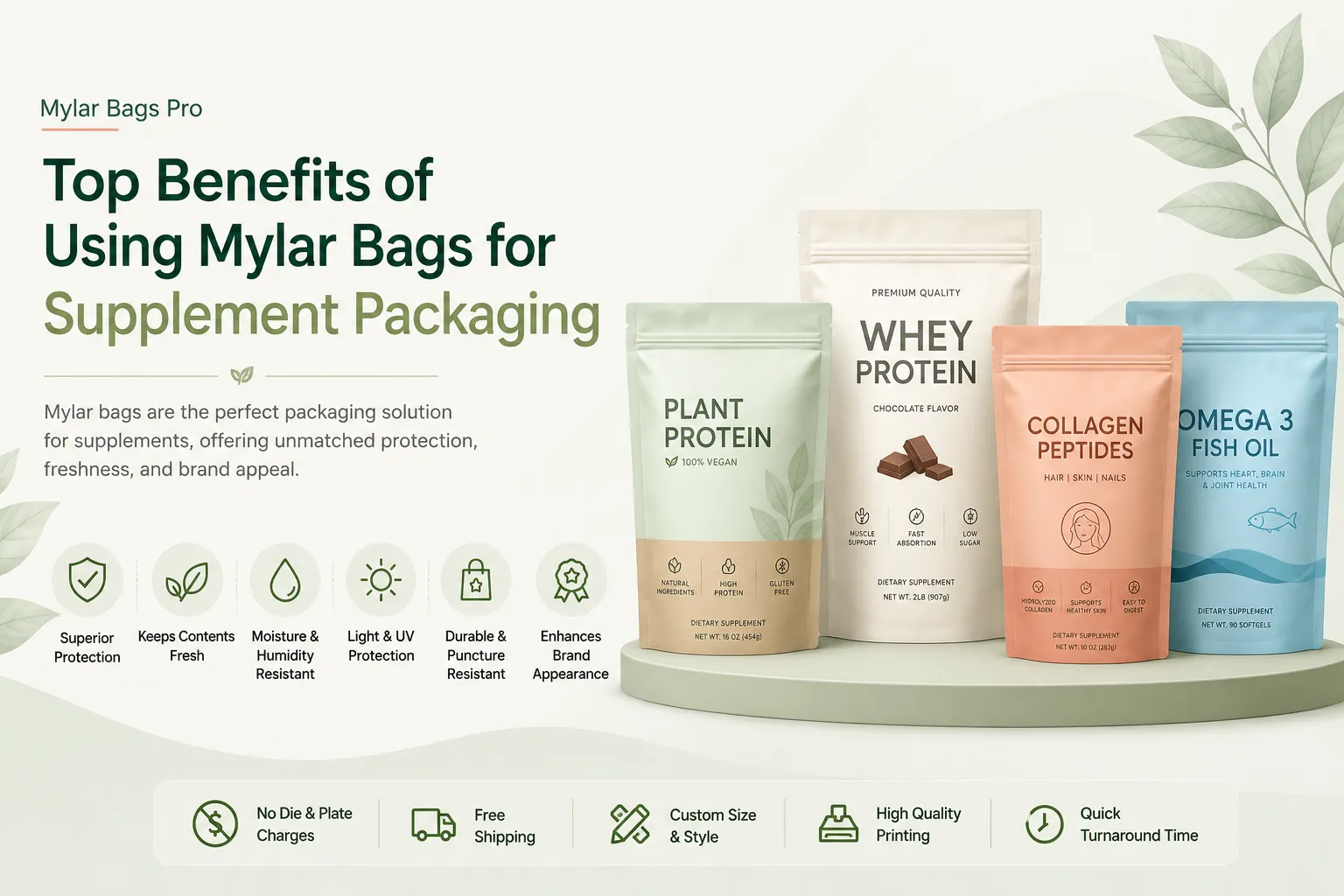
Supplement capsules and powders break down fast once air and light reach them. A bottle that looked fine in the warehouse can lose potency within months if the packaging cannot hold back oxygen and moisture. That is the problem mylar bags for supplement packaging were built to solve. Companies such as Mylar Bags Pro work with supplement brands that need a pouch tough enough to protect probiotics, protein powder, and capsules through shipping, storage, and months on a shelf.
Why does packaging matter this much for a supplement brand? A product inside a weak bag degrades before a customer ever opens it, and a customer who receives a clumped powder or a faded label will not reorder. Mylar pouches solve this with a layered barrier that standard plastic cannot match. This piece covers the benefits, the material choices, real cost drivers, and the questions supplement brands ask most before placing a packaging order.
A mylar bag is a stack of thin layers, usually polyester, aluminum foil, and polyethylene, bonded together to block oxygen, moisture, and light at the same time. Standard poly bags let air pass through slowly, and that slow leak is enough to oxidize fish oil, break down probiotics, or dull a bright powder within weeks.
Independent barrier testing on PET, aluminum, and PE laminates puts oxygen transmission below 0.01 cc per square meter per day, according to MarkWide Research (2026). Standard plastic film runs far above that figure. The gap matters most for probiotics, omega-3 softgels, and powder blends with active enzymes, since a pouch that keeps oxygen out keeps the label claim on the front of the bag accurate.
Light exposure causes a second kind of damage. Vitamin C, several B vitamins, and most probiotic strains break down faster under UV and fluorescent light. A metallized mylar layer blocks nearly all visible light, protecting potency in a way a clear stand-up pouch cannot.
Moisture is the third threat, and it shows up fastest in powders. A mylar pouch with a low moisture vapor transmission rate keeps protein powder and greens blends from clumping in humid warehouses or during ocean freight. This barrier strength is part of why the global flexible packaging market reached an estimated USD 239.61 billion in 2025 and was on track to climb past USD 253 billion in 2026, with bags and pouches holding the largest share of packaging types on the market.
Not every supplement needs the same bag. A gummy vitamin brand has different needs than a bulk protein powder manufacturer, so the material stack, thickness, and closure style all shift based on the product inside.
| Material Type | Avg. Thickness | Oxygen Barrier | Best For | Maintenance/Handling |
|---|---|---|---|---|
| Standard PET/AL/PE laminate | 3.5 mil | High | Capsules, tablets, softgels | Heat-seal only, no reseal |
| Heavy-duty foil laminate | 5.0 mil | Very high | Bulk powders, long shelf-life SKUs | Ships and stacks well, minimal punctures |
| Clear-window metallized mylar | 4.0 mil | Moderate-high | Gummies, retail shelf display | Keep window side away from direct sunlight |
| Child-resistant zipper mylar | 4.5 mil | High | Melatonin, iron, adult-strength formulas | Zipper track needs a clean, dry seal each close |
A clear-window bag sells product on a retail shelf but trades away a fraction of the light barrier a fully metallized bag offers. A brand shipping direct-to-consumer online rarely needs that window, and a heavier foil laminate protects the product better in transit. A supplement with a bittering agent or a child-resistant labeling requirement needs the reinforced zipper track, since a standard zipper will not meet state and federal child-resistant packaging rules for products like iron or melatonin.
Getting from raw film to a shelf-ready pouch runs through a few consistent steps, and knowing them helps a brand spot a rushed production run before it becomes a returned shipment.
First, the supplier laminates the film layers, typically PET on the outside for print quality, aluminum in the middle for the barrier, and PE on the inside for heat-sealing. Next, the printer applies branding using flexographic or digital printing, depending on order volume. Smaller supplement brands running under 5,000 units usually get better pricing and faster turnaround from digital printing.
After printing, the film is die-cut and formed into the bag style, stand-up pouch, flat pouch, or gusseted bag, and the zipper track and any spout or valve get added at this stage. The empty bags then move to the filling line, where the co-packer loads product by weight, adds an oxygen absorber if the formula calls for one, and heat-seals the top. A batch code and expiration date print or apply during this final step, satisfying supplement labeling rules under FDA 21 CFR Part 111.
Cost questions come up early in nearly every supplement packaging conversation, and the number moves based on several factors rather than one flat rate.
Order volume has the biggest effect. A 500-unit test run costs more per bag than a 50,000-unit production order, because setup and plate costs get spread across fewer units. Thickness and barrier level come next. A 5.0 mil foil laminate for long shelf-life products costs more than a 3.5 mil standard bag, and a child-resistant zipper adds a premium over a standard reclosable track.
Print complexity plays a role too. A two-color print job on a stock bag runs cheaper than a full-color, edge-to-edge custom design, and a digital print run works better for short runs while flexographic printing brings the per-unit price down at higher volumes. A packaging engineer who works with California-based co-packers put it plainly: brands that lock in their artwork and specs before quoting avoid the reprint costs that eat into a first order's margin.
A brand deciding between suppliers should ask what separates a specialist from a general packaging reseller. A supplier who works only with mylar pouches for supplements and food, like Mylar Bags Pro, has already solved for oxygen absorber compatibility, FDA-compliant inks, and the minimum order quantities that fit a growing supplement brand's budget. A general packaging broker selling everything from shipping boxes to retail bags rarely carries that depth on barrier film or child-resistant compliance.
Ask a potential supplier three things before signing an order. Does the film meet FDA food-contact standards for the type of supplement being packed? Can the supplier confirm the oxygen transmission rate and moisture barrier rating in writing rather than a general marketing claim? And what is the actual minimum order quantity, since a quoted low price often hides a 10,000-unit minimum that does not fit a smaller brand's cash flow.
A small nutraceutical brand launching its first collagen powder SKU ran into this directly. Its first supplier quoted a low per-unit price but required 25,000 units, tying up capital the brand needed for marketing. Switching to a supplier offering a 2,000-unit minimum on a 4 mil foil laminate let the brand test the market, confirm sell-through, and reorder at a larger volume once demand proved out.
If you want a packaging partner that understands supplement shelf-life requirements and FDA labeling rules for this category, Mylar Bags Pro offers sample kits and can quote against your specific formula and order size. Getting a firm barrier spec and an honest minimum order quantity in writing before you commit saves both money and time on your first production run.
What makes mylar bags better than plastic bags for supplements? Mylar bags use an aluminum or metallized layer that blocks oxygen and light far better than single-layer plastic film. This keeps potency-sensitive ingredients like probiotics and fish oil stable for longer, and it keeps powders from clumping in humid conditions.
How much do custom mylar bags for supplement packaging cost? Pricing depends on thickness, print complexity, and order size. A basic 3.5 mil bag with simple printing can run under a dollar per unit at higher volumes, while a heavy foil laminate with a child-resistant zipper and full-color print costs more per unit, especially on smaller runs.
What is a typical minimum order quantity for supplement pouches? Minimums range widely, from around 500 to 1,000 units for digitally printed short runs up to 25,000 units or more for flexographic print jobs. Brands testing a new SKU should ask for the lowest minimum a supplier offers before committing to a full production run.
Do mylar bags for supplement packaging need FDA approval? The film itself needs to meet FDA food-contact material standards, and the finished label needs to follow supplement labeling rules under 21 CFR Part 111, covering batch codes, ingredient panels, and expiration dating. The bag material and the label content are reviewed separately.
Can mylar bags keep gummies fresh in humid climates? Yes, provided the bag uses a strong moisture vapor barrier. Gummies are especially prone to sticking together or drying out, so a foil-laminated bag with a proper heat seal protects texture better than a thin plastic pouch in humid shipping or storage conditions.
Are mylar bags recyclable for supplement brands in the UK and Canada? Standard multi-layer mylar is difficult to recycle through curbside programs because of its mixed-material construction. Brands selling into the UK or Canada should check current extended producer responsibility rules in each market, since recyclability requirements are tightening across several regions.
What thickness of mylar bag is right for capsules versus powder? Capsules and tablets generally do well in a 3.5 mil bag, since the product itself is more stable than a fine powder. Powders benefit from a 4.5 to 5.0 mil bag with a stronger moisture barrier, since exposed powder surface area degrades faster than a solid capsule shell.
Do supplement mylar bags need an oxygen absorber inside? Not always. Fast-turnover retail products with a shelf life under a year often skip the oxygen absorber. Long-shelf-life bulk powders, especially those with fish oil or probiotics, benefit from an oxygen absorber packed inside the sealed bag for extended stability.
How long can supplements stay fresh in a properly sealed mylar bag? With the right barrier film and, where needed, an oxygen absorber, many dry supplement powders can hold nutritional value well beyond their printed shelf-life date. Capsules and softgels typically follow the shelf life set by the formula itself rather than the packaging alone.
What permits or regulations apply to child-resistant supplement packaging? Products containing iron, melatonin above certain doses, or other regulated ingredients may fall under state-level child-resistant packaging requirements in the US. Brands should confirm requirements with their formulator or regulatory consultant before finalizing a zipper style, since rules vary by ingredient and by state.
Is custom printing available on small mylar bag orders for supplement startups? Yes. Digital printing supports full-color custom artwork on smaller runs, often starting in the low thousands of units, which makes it a workable option for a new supplement brand that is not ready to commit to a large flexographic print order.
Do mylar bags for supplement packaging work for international shipping to Australia or New Zealand? Mylar's strong moisture and oxygen barrier holds up well over long transit times, which matters for shipments to Australia, New Zealand, or other distant markets. Brands shipping internationally should confirm the destination country's supplement labeling rules separately from the packaging material itself.